Takeoff-Only vs Full Construction Estimate: Which Does Your Project Need?

Takeoff-Only vs Full Construction Estimate: Which Does Your Project Need?
A builder can waste money by outsourcing too much estimating. They can also lose far more by outsourcing too little.
That is the real decision behind choosing between a takeoff-only service and a full construction estimate.
If your business already has current supplier rates, reliable subcontractors, known labour outputs and an established way of calculating preliminaries, overheads and margin, paying someone else to rebuild all of that commercial knowledge may add little value. What you may actually need is help with the time-consuming measurement work.
The opposite situation is equally common. A builder receives an accurate takeoff, but still has to decide which rates to use, interpret incomplete documentation, obtain trade pricing, estimate labour productivity, calculate preliminaries and identify project risk. In that situation, the takeoff has solved only one part of the estimating problem.
A takeoff-only service gives you the measured scope to price. A full construction estimate takes that measured scope and develops it into an expected project cost.
The right choice depends less on project size than on the pricing knowledge, estimating capacity and commercial experience already inside your business.

Takeoff-Only vs Full Estimate: The Short Answer
Takeoff-only is generally the better fit when you trust your own rates and commercial judgement but need reliable quantities.
A full estimate is more appropriate when you need somebody to handle both measurement and pricing.
There is also a useful middle ground. Many experienced builders outsource measurement, retain familiar trade pricing internally and seek additional estimating assistance only for packages where their cost knowledge is weaker.
The objective is not to outsource as much estimating as possible. It is to remove the part of the estimating process that consumes time or creates risk.
For a broader explanation of the documents themselves, see our guide to construction takeoff vs estimate vs BOQ.
The First Question Is Not How Big the Project Is
It is tempting to assume that small jobs need takeoffs while larger projects need full estimates. In practice, that is a poor way to decide.
Consider an established residential builder in Brisbane pricing another custom home in an area where the company works regularly. The builder knows the concreter, carpenter, roofer, electrician and plumber. Supplier pricing is current, labour productivity is understood, and the business knows what margin it needs.
Pricing knowledge is not the problem.
The problem might simply be workload. Several tenders have arrived together, and nobody has two days available to measure concrete, framing, linings, roofing, finishes and external works.
That is an excellent case for a construction takeoff service. The external estimator removes the measurement burden while the builder retains the commercial knowledge that already works.
Now give the same builder a three-level townhouse project with basement excavation, fire separation, more complex services and restricted access.
The builder has not become less capable. The estimating problem has changed.
Rates that worked on detached housing may not transfer neatly. Trade interfaces matter more, preliminaries become larger and the cost of misunderstanding a package increases.
The estimating service should therefore follow the project risk and internal capability, not simply the contract value.
If a takeoff-only service is right for your project, Estimating Australia provides professional residential construction takeoff services for builders, contractors, developers and owner-builders across Australia.

When Takeoff-Only Is the Smarter Option
Takeoff-only works particularly well when measurement is the bottleneck but pricing is not.
Consider a roofing and cladding contractor in Perth. The business may know exactly what its crews can install in a day, have current supplier arrangements and already understand its allowances for craneage, fixings, insulation, freight, waste and margin.
When a major tender arrives, the contractor does not necessarily need somebody else to determine what roofing costs. It needs somebody to accurately measure roof areas, profiles, flashings, cappings, gutters and insulation so the internal estimator can price quickly.
The same model can work for a concreting contractor in Adelaide, a plastering contractor in Melbourne, a civil contractor in Newcastle or a residential builder on the Gold Coast.
The commercial knowledge remains inside the business. The external estimator provides additional measurement capacity.
This is also why takeoff-only works well as overflow support. Tender volumes are rarely consistent. A builder may have quiet periods followed by three or four opportunities arriving together. Outsourcing measurement during those peaks can increase estimating capacity without handing over supplier rates, subcontractor relationships or final tender strategy.
Our guide to whether builders should outsource construction estimating explores this model in more detail.
The Limitation: A Takeoff Does Not Make the Commercial Decisions
A detailed quantity report can create the impression that most estimating work is already complete.
Sometimes it has. Sometimes it has not.
Consider an extension and substantial renovation in inner Sydney. The drawings may allow the estimator to measure new walls, roofing, structural steel, concrete and finishes accurately.
Those quantities do not tell the builder how much it will cost to move demolition waste through restricted access. They do not account for temporary protection, scaffolding, difficult excavation, existing services, or the additional supervision required when new construction interfaces with an old structure.
The takeoff may be completely correct, and the price can still be wrong.
This is where a full construction estimate becomes more valuable. It takes the measured scope and applies construction judgement to how the project is likely to be delivered.
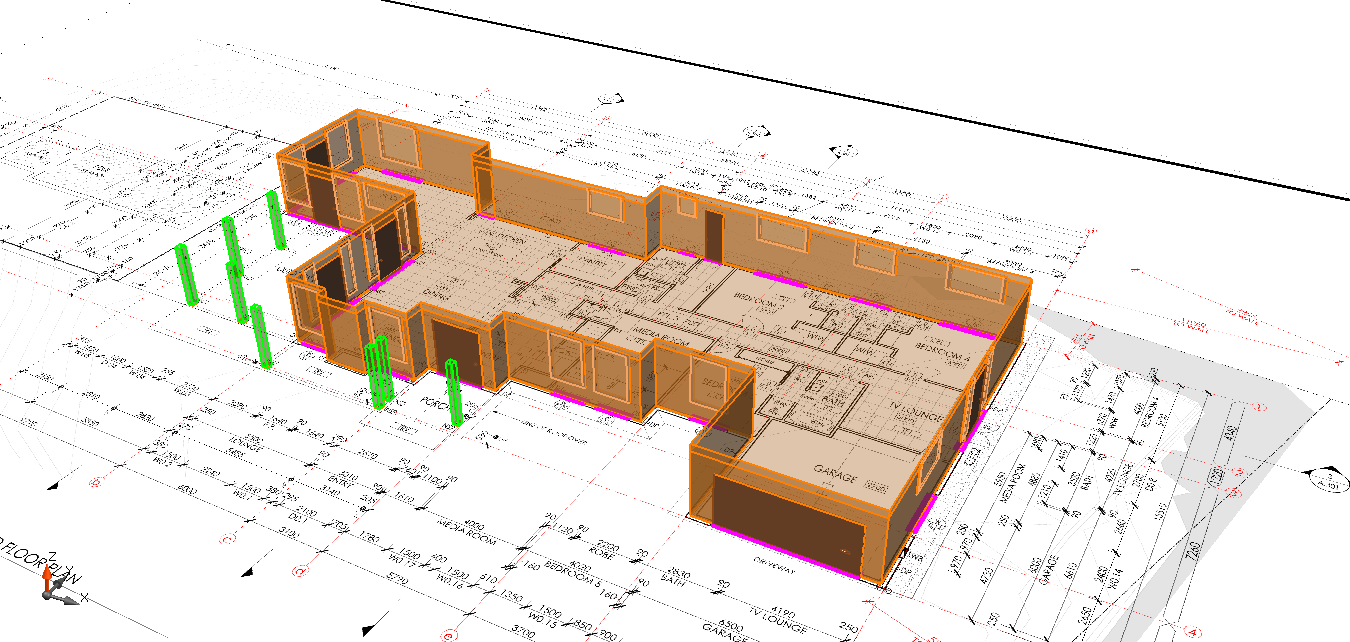
What a Full Construction Estimate Adds
A full estimate should answer a harder question than "how much material is shown on the plans?"
It needs to answer: what will it realistically take to deliver this work?
That requires the estimator to connect measured quantities with material supply, labour productivity, subcontractor costs, plant, site establishment, temporary works, access, supervision and preliminaries.
It may also require judgement around prime cost items, provisional sums, incomplete documentation and construction methodology.
This is why two estimators can begin with exactly the same quantities and still arrive at different project costs.
Suppose the drawings contain 100 square metres of a particular wall system. One estimator may assume straightforward access, normal productivity and a familiar subcontractor rate. Another may recognise difficult access, significant services coordination and a compressed programme.
The measured quantity is identical. The cost is not.
That is the part of estimating that software cannot solve on its own. Measurement technology can calculate an area very accurately, but construction experience is still required to understand what has been designed, what has not been shown clearly and what will actually be required on site.
A full estimate should also make uncertainty visible. If the retaining wall design is incomplete or a services package is not yet resolved, the estimate should identify the assumption rather than hiding uncertainty behind a precise-looking number.
The Handover Between Measurement and Pricing Matters
One of the most overlooked risks in takeoff-only estimating is the handover between the person who measures the project and the person who prices it.
Imagine an external estimator measures a commercial fit-out in Melbourne. The returned quantities include plasterboard walls, ceilings, doors and floor finishes. The builder's estimator then applies internal rates.
That works well until the quantities lose important context.
Some walls may be fire-rated. Others may have acoustic requirements. Access may be restricted to a goods lift. Part of the work may need to occur outside normal trading hours. Ceiling installation may require substantial coordination around services.
If those conditions are noticed during measurement but don't transfer into pricing, the quantity can be right while the tender is wrong.
A good takeoff therefore needs to be more than a spreadsheet of numbers. It should identify drawing revisions, separate scope clearly and record assumptions that matter to the person pricing the work.

Quantities Travel Better Than Prices
A square metre of wall can be measured from a PDF whether the project is in Brisbane, Sydney, Hobart or Perth.
The construction price can change considerably.
Material supply, freight, labour availability, subcontractor competition, site access and programme pressures all affect the rate eventually applied.
Current Australian construction price data reinforces this point. The Australian Bureau of Statistics continues to report different construction cost movements across states and capital cities. See the ABS Producer Price Indexes for Australia.
The practical lesson is more important than the index itself:
Quantities are primarily drawing-specific. Pricing is project-specific and market-specific.
This is one reason takeoff-only can be a strong choice for an experienced local builder. A contractor in Hobart may know local subcontractor behaviour better than an external estimator. A regional Queensland builder may have established methods for freight, travel and accommodation. A Perth contractor may already understand current labour availability across its regular trades.
In those cases, outsourcing measurement while retaining local pricing can produce a better result than outsourcing commercial knowledge the builder already possesses.
The reverse is also true. If a contractor is tendering in an unfamiliar market, relying on old internal rates can create more risk than asking for broader estimating support.
Brisbane, Sydney and Regional Australia: Three Different Decisions
A Brisbane builder pricing another two-storey custom home with familiar trades and current rates is a natural takeoff-only candidate. The external estimator measures the project, while the builder retains control of supplier pricing, subcontractors, preliminaries and margin.
An inner-Sydney renovation can present the opposite problem. The visible work may be easy enough to measure, but restricted access, demolition uncertainty, temporary works and existing conditions can have a larger effect on cost than small differences in quantities. Unless those risks are being assessed confidently in-house, fuller estimating support is more appropriate.
Regional and remote work introduces another variation. A Darwin civil contractor may have excavation, drainage, pavement and concrete quantities that are straightforward to measure, while mobilisation, plant availability, freight, fuel and seasonal conditions drive the real cost. A regional Western Australian contractor may understand those local delivery costs far better than an external estimator.
The lesson is not that one service suits one location. It is that the correct division between measurement and pricing depends on where the useful knowledge sits.

When Takeoff-Only Becomes False Economy
A version of takeoff-only can look inexpensive at the start and become expensive by the time the tender is complete.
The builder outsources the measurement. The takeoff arrives. Someone internally then spends hours working out what the quantities mean, obtaining supplier rates, chasing subcontractors, identifying missing scope, building preliminaries and correcting assumptions.
The business selected takeoff-only because it cost less than a full estimate, but most of the internal workload remained.
Sometimes the process becomes even more fragmented. One person measures the job, another prices major trades, a project manager provides allowances, and the director adjusts the total before submission. Nobody has complete ownership of the estimate.
This is not a reason to avoid takeoff-only. It is a reason to identify the real bottleneck before choosing it.
If measurement consumes most of your estimating time, outsource measurement. If the real problem is pricing, subcontractor engagement, scope interpretation, preliminaries or commercial risk, measurement alone will not solve it.
When a Full Estimate Is Worth It
Full estimating tends to create more value when the project is outside the company's normal experience, current rates are weak, documentation requires substantial interpretation or nobody internally has enough time to turn the quantities into a reliable commercial position.
It can also be valuable when the estimate is being used for more than an internal builder's tender.
A developer assessing feasibility needs to know whether a proposed project is commercially viable. An owner-builder may need an independent cost breakdown before approaching contractors. A commercial contractor may face more trade packages than its internal team can properly assess before tender close.
A civil contractor moving into a new type of work may have excellent construction knowledge but little historical cost data for that particular scope.
In these cases, a full construction estimating service provides something fundamentally different from a quantity takeoff. It provides the commercial framework around the quantities.

The Hybrid Model Is Often the Best Answer
The choice does not have to be all or nothing.
A Gold Coast builder might confidently price its normal structure and finishes but need more assistance with a complex basement and retaining package. A Newcastle commercial contractor might retain its usual subcontractor pricing but outsource measurement and pricing support for an unfamiliar facade package.
A regional Queensland builder may use externally prepared quantities while applying its own freight, accommodation and mobilisation allowances because those costs are specific to how the company operates.
This hybrid approach lets the builder keep its strongest commercial knowledge while buying additional expertise only where it adds value.
It is also an effective way to scale estimating capacity without changing the whole process whenever tender workload increases.
How to Decide Before Sending the Plans
Before choosing between takeoff-only and full estimating, look closely at what your team already does well.
If your supplier rates, subcontractor pricing, labour productivity, plant allowances, preliminaries and overhead recovery are current and reliable, measurement may be the only part worth outsourcing.
If nobody internally has enough time to price the quantities properly after they arrive, takeoff-only is less likely to solve the problem.
Project familiarity also matters. A builder repeatedly pricing the same style of residential work has a very different cost knowledge base from a contractor moving into unfamiliar commercial, civil or multi-residential work.
Documentation quality matters too. Developed drawings and clear specifications reduce uncertainty. Incomplete documentation requires more assumptions and therefore more estimating judgement.
Most importantly, identify where the tender risk actually sits.
If the problem is simply that your estimating team cannot measure every opportunity arriving, takeoff-only can be highly effective. If the risk sits in unclear scope, unfamiliar packages, outdated rates, unusual access or complex preliminaries, full estimating support is more likely to address the actual problem.
What Should a Good Takeoff-Only Service Provide?
Takeoff-only should still be professional estimating work.
The output should make clear what has been measured, which drawings and revisions were used, how the quantities are structured and what assumptions or exclusions affect the result. It should also be clear whether quantities represent net measured scope or include agreed waste or procurement allowances.
Where useful, marked-up drawings make the takeoff easier for an internal estimator to check and price.
The structure should also reflect how the quantities will be used. A plastering contractor tendering one package does not need the same output as a head contractor pricing an entire development.
A takeoff is only valuable when the person responsible for pricing can understand, audit and trust it.
For more detail, see our guide to material takeoff vs quantity takeoff.
Frequently Asked Questions
Is Takeoff-Only Cheaper Than a Full Construction Estimate?
Takeoff-only normally has a narrower scope because the estimator measures the project rather than completing the whole pricing exercise. If your team can efficiently apply current rates and complete the commercial review, it can provide excellent value. If substantial internal work is still needed after delivery, a full estimate may be more efficient overall.
Can I Use a Takeoff Directly to Submit a Tender?
Usually not. A takeoff provides the measured basis for pricing, but the builder still needs to consider labour, materials, subcontractors, plant, preliminaries, overheads, risk and margin before deciding the final tender amount.
Is Takeoff-Only Suitable for Residential Builders?
Yes. It works particularly well for experienced residential builders with current supplier rates, established subcontractors and a repeatable estimating process. More unusual projects or projects with significant site risk may justify fuller estimating support.
Should Subcontractors Use Takeoff-Only Services?
Often, yes. Trade contractors frequently know their own labour productivity, supplier arrangements and margins extremely well. Outsourcing measurement can remove a significant tendering workload without replacing valuable trade-specific pricing knowledge.
Can I Outsource Only Part of the Estimate?
Yes. A hybrid approach can be very effective. You can outsource whole-project measurement, retain familiar pricing internally and seek additional estimating support for unfamiliar or higher-risk packages.
Which Is More Accurate, a Takeoff or a Full Estimate?
They measure different things. A takeoff can be highly accurate as a measurement of documented scope. A full estimate addresses cost, so its reliability also depends on rates, assumptions, subcontractor pricing, site conditions and the quality of the project information.
A perfect takeoff cannot make poor pricing accurate.
The Better Question Is What Your Team Actually Needs Help With
The decision between takeoff-only and full construction estimating shouldn't be based on choosing the cheapest service or the most comprehensive package.
Start with the problem.
If your estimator is buried in drawings but already knows how to price the work, remove the measurement workload. If your business lacks the time, current rates or experience to turn those quantities into a reliable project cost, a full estimate solves the larger problem. If your team is strong in some packages and weaker in others, divide the work intelligently.
Do not outsource commercial knowledge you already have. Equally, do not keep commercial risk in-house simply because that is how the business has always done it.
The strongest estimating process has a clear division of responsibility. The right person measures the scope, the right person applies the rates, and somebody with enough construction experience reviews the complete number before it becomes a tender, quote or project budget.
Need the Measurement, the Pricing, or Both?
Estimating Australia supports builders, subcontractors, developers and construction teams across Brisbane, Sydney, Melbourne, Adelaide, Perth, Darwin and regional Australia.
If your business already has trusted supplier, subcontractor and labour rates, we can prepare the measured quantities while your team retains control of pricing and margin.
Explore Our Construction Takeoff Services
If you need the measured scope developed into a detailed project cost, we can provide broader estimating support to suit the project and tender stage.
Explore Our Construction Estimating Services
The goal is not to outsource more estimating. It is to outsource the right part of it.
Offices
100% ONLINE
P: 1300 944 122
Call to arrange an online meeting.
Our Estimators are 100% Local,
With a long history of experience in
your industry, we know YOU.
Head Office / Administration
Brisbane
Postal Details
Suite 279 /
4/16-18 Redland Bay Rd
Loganholme
QLD 4129
All Enquiries
P: 1300 944 122
Sydney
Postal Details
Suite 279 / 377 Kent St
Sydney
NSW 2000
All Enquiries
P: 1300 944 122
Melbourne
Postal Details
Suite 271 /
439 Little Bourke St
Melbourne
VIC 3000
All Enquiries
P: 1300 944 122
Phone
1300 944 122